
Artistic Social Activites
ZARARTI strives to bring theatre to communities that normally struggle to gain access to cultural entertainment. These include the residents of homes for the elderly and patients of geriatric hospitals, the visually impaired, and others. Over the years, ZARARTI has staged numerous productions for such audiences, some of which were specifically written for or performed by the participants themselves.
Various members of ZMCA have been doing pioneering work in helping members of society with special needs to participate in mainstream artistic activities.
THEATRE FOR THE DEAF
In 1978 Narcy volunteered for two seasons to teach mime at a dedicated school for children who were hard of hearing. At the end of the course, he organised a theatre presentation which included the special pupils who mimed all the parts of the Classical Greek story of Androcles and the Lion. The lion actor stole the show. Mainstream pupils performed a spoken play. The special pupils were then mixed with the mainstream pupils to do a group performance of mime, song and dance. The family and friends present in a big theatre at the Junior College enjoyed the whole evening of dramatic art without bothering to distinguish who was doing what.
THEATRE FOR THE HOMEBOUND ELDERLY
As part of its annual activity at the theatre of the St Vincent de Paule home for the elderly, ZARARTI puts on a Commedia dell’Arte production once a year. The main audience is from the home for the elderly itself. The majority are residents who are not mobile and attend using a wheelchair. These are citizens who never have an opportunity to attend theatre activities in public.
There is a phenomenon in Malta which establishes a condition that when an elderly person is settled in a retirement home, whether a government entity or private, that a patient is restricted in his/her possibilities of socialising outside the home. ZMCA resolved in 2023 to mitigate this situation wherever possible.
Through the Ministry for Active Aging a programme of itinerant theatre productions was initiated using talent within ZMCA membership and beyond.
A number of long-established and well-known popular comedies were re-written to accommodate the modality of the production according to the administrative exigencies of each retirement home willing to welcome this programme. Some original plays were written purposely for this programme.
The policy was to offer a visiting performance to homes who had the space to accommodate a small theatre company. Some offer their chapel or their dining room. Others offered a garden space or the main reception hall. ZMCA’s company of actors adjusted accordingly to the best potential of each case.
This way those retirement home residents who hardly have the faculty to travel outside the home had the privileged possibility of having a theatre company visiting their home to provide an hour of entertainment. In each case ZMCA assured a high professional standard. Popular actors who are well known on television were chosen, at least one per production. The directors insisted on the visual aspect in caring for colour schemes in the costumes and mise-en-scène. All plays were in the vernacular. The themes chosen were the current common challenges of the day in Malta. The emphasis was on entertainment and wherever possible a sing-along session was built into the script. There was a lot of audience participation when the comedians were asked to break the fourth wall and involve the audience. The audiences were always enthusiastic. At the end of each performance the universal cry was always, ‘When are you coming back?’
In fact, ZMCA chose 10 homes for the elderly spread all over Malta. It produced 8 different comedies and performed each one in 5 different homes. Overall, in one season, 40 performances were provided for hundreds of old people’s homes’ residents.


THEATRE FOR THE BLIND
After a few years, ZARARTI tried another experiment used by the National Theatre in London, Theatre for the Blind. They engage a stand-up comedian to hide in the orchestra pit and give a running commentary of the action on stage through a microphone. Each blind person in the audience was given a dedicated earphone to hear the commentary. Before the play starts, the five actors wearing their iconic Commedia costumes and relative character masks go to speak to each blind person individually. Each actor uses the typical voice and attitude of the character involved. He offers the blind member of the audience to feel the texture of the costume and the shape of the mask and personal props the character has to carry. By then the blind member of the audience would be able to recognise the voice and relate it to a shape of costume. Through the earphone the member of the audience can hear the running commentary describing the action and the comic slapstick. The special guest can also hear the reaction of the rest of the audience as well as the lines and their interpretation by the actors. This is a total experience the like of which few blind people get to participate in during a lifetime.
THEATRE FOR THE MENTALLY-CHALLENGED
ZARARTI did these performances once a year for the first two years. Then in the third year they started to regularly include a number of mentally-challenged youths from government Day Centres and relative institutions. For everyone, these activities became a favourite outing.
OTHER INITIATIVES
As a Voluntary Organisation, ZARARTI is managed by a team of like-minded individuals who share principles of cultural and artistic expression, and social commitment, both within ZMCA’s programme of activities and in an individual capacity.
In their own way, independently and as a group, ZARARTI’s team members are intent on experimenting on pioneering possibilities to ensure inclusivity as they share their talents with the community.
We have Frederick Camilleri, a member of ZMCA, who on a personal initiative takes a group of teenagers from his church parish every Saturday evening and devises a re-enactment of the following Sunday morning’s Gospel stories. The next day during mass Frederick and his group of young actors perform the gospel of the day story in the vernacular.
Another ZMCA member is Michael Piscopo who is best known for being the co-creator (together with his wife Suzanne) of FONZU L-FENEK – a popular children’s rabbit character promoting healthy eating and a sustainable lifestyle. With a consistent presence in local schools and at public events, and a popular theme song written by Michael which was played more than 2 million times to date, Fonzu became a household name and a cultural icon, known by everyone and loved by many. For the past fifteen years, Michael has been using Fonzu to benefit Maltese children and their families.
In 2018 Narcy Calamatta the ZMCA founder/president tried out an experiment for the closing day of the festival for Valletta European City of Culture 2018. As part of the festival to promote the art of folk story-telling the story-telling protagonists were given the opportunity to present a performance highlighting a typical local story which depicts Love and Loss.
Narcy chose to weave together two traditional stories. The Bride of Mosta (L-GĦARUSA TAL-MOSTA) who is abducted from a church altar on her wedding day by a Moor. Here, the unidentified Moor is shown in a bad light. There is another story of another mysterious Moor (ĦASAN) who used to abduct any young girl who ventured close to a cave known as Ħasan’s Cave. This cave which really exists is hanging on a cliff face and encloses a labyrinth of stalactites and stalagmites. It is dangerous for unaccompanied children, hence the origin of the story to scare children away.
Narcy wrote a play about a young bride from Mosta who escapes from a forced marriage ceremony and hides with Hasan in his cave. They fall in love but cannot get married because of the difference of their religions. She becomes a nun and he is the madman who stands below her window every night to sing his love for her.
To perform this 24-character play, Narcy trained the residents of a private retirement home, Casa Arkati in Mosta. Seven of the characters playing a sort of Greek chorus were wheelchair-bound and read their speeches in unison. Some of the Caring Staff from the Home played the younger parts. The experiment was a success.
The following year Narcy offered the idea of getting the elderly to perform a play to the minister of Active Aging. The Minister authorised a budget and Narcy went to the Mellieha Day Centre for Active Aging and along with the members of 60+ retirees he wrote a nativity play (ANĠLU BELLU). The members included their other activity of choir singing in the play script and sang all the Maltese Christmas Carols as part of the story.
Members of ZARARTI filmed their first show with 3 cameras. The edited film was launched on YouTube and was very well received. On their own initiative the Day Centre staff put on the play for the home-bound members of the nearby Home for the Elderly. The local mayor also engaged them to perform for a Christmas festival in the main village square. The active aging members are now taking initiatives to write their own plays and perform them for families and friends.
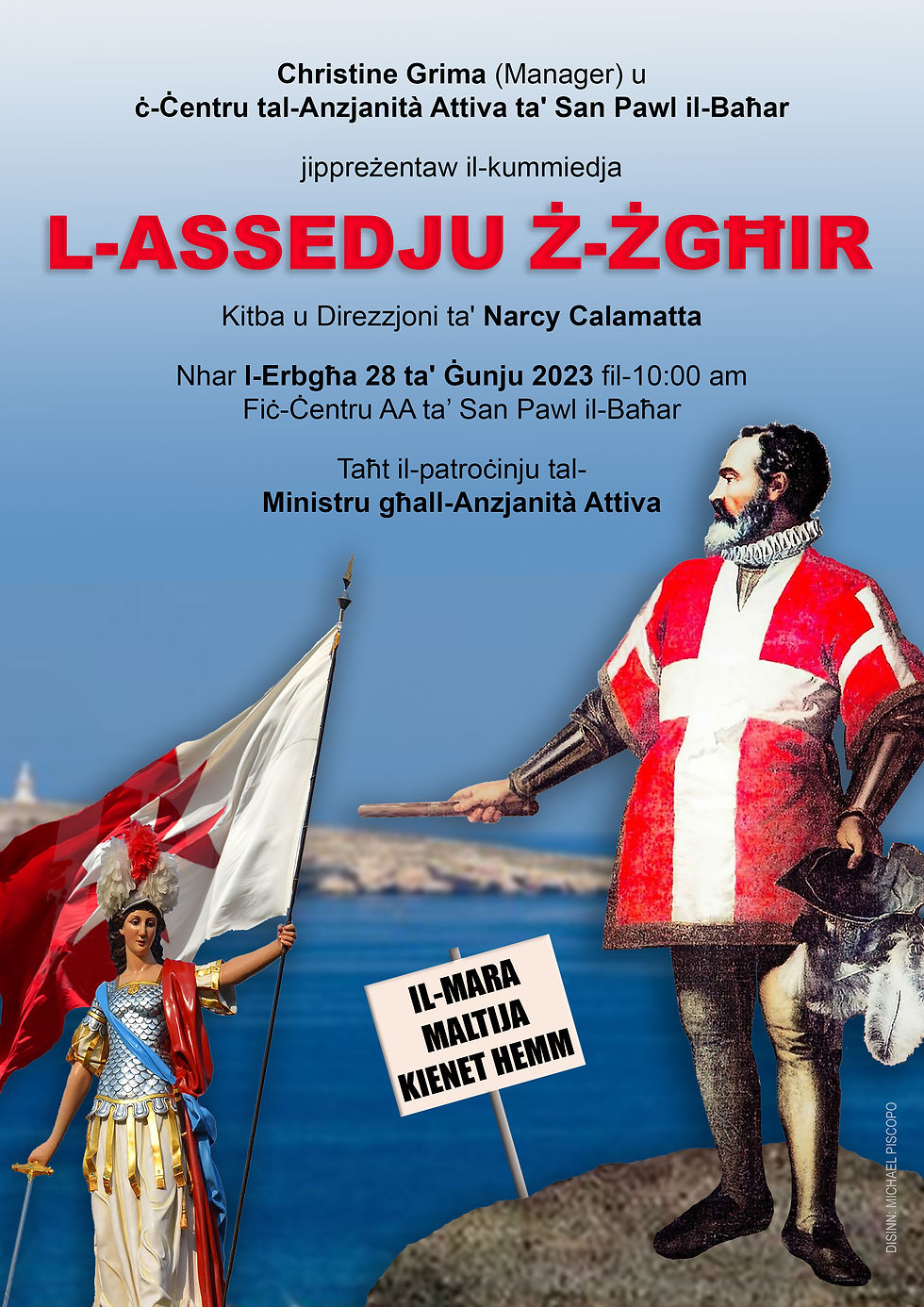
This pioneering exercise took flight and the following year the local Day Centre for Active Aging in St, Paul’s Bay asked Narcy to write them a play and produce it for them. Narcy gladly obliged and he wrote a parody on the occasion of the National holiday to celebrate the historical Great Siege of Malta 1565. Narcy called his opus the Small Siege of Malta (L-ASSEDJU Ż-ŻGĦIR). In it he argued that it is not fair that the thousands of Maltese women who must have helped win the battle in 1565 are never mentioned in history books. The members of the St Paul’s Bay Day Centre were 12 women and one man. They were very proud they had the occasion to stand up to history.



ANNUAL FESTIVAL BY AND FOR THE ELDERLY
After this the Ministry for Active Aging decided to exploit this play-producing phenomenon. They asked the National Theatre of Malta, Teatru Malta to organise play productions in all the six geographic regions of Malta. This is how Klabb Sittin+ (Club 60+) came about – a festival came about. A year-long engagement involving weekly workshops and rehearsals for groups of elderly enthusiasts and culminating in a three-day festival called Ġambori’ (Jamboree) where the plays get to be performed on a professional stage.
This year 2026 marks the third year that this drama festival is being organised. Last year, 2025, there were 80 elderly members who took part in six plays which were performed three times in Malta and once on the island of Gozo.
ZARARTI AND FILMMAKING
ZMCA is continually using filmmaking as an educational tool. To promote awareness of the Maltese Cultural Heritage of Commedia dell’Arte they produced two pilot films. These are short films of a performance of a Commedia dell’Arte sketch with actors in characteristic costumes and masks. After the 10 minute sketch there is an expert explaining the analysis of the featurette. These pilot projects are being used as promotion for a potential series of educational videos for local television.
ZMCA also made a period costume film L-ISPIŻJARA (The Pharmacist) telling the story of an obscure historical character, Caterina Vitale (1566 - 1619). It is the life story of the unique female pharmacist who served the Knights of Malta in their hospitals in the renaissance. This extraordinary lady was a philanthropist but also a controversial figure in society.
This video is available on YouTube and other social media as part of the campaign of promoting the importance of women in Maltese History. This is also a pilot project proposing a local TV series.
As part of the series of film fora organised by the Malta University of the Third Age, L-ISPIZJARA was shown with a Q&A discussion led by Anthony Ellul, the ZMCA film sector officer, and Michael Piscopo who wrote the script. Michael also presented another one of his short films produced by ZMCA - “IL-BILJETT” (The Ticket) that deals with the way that greed and money can disrupt dynamics in a family setting.
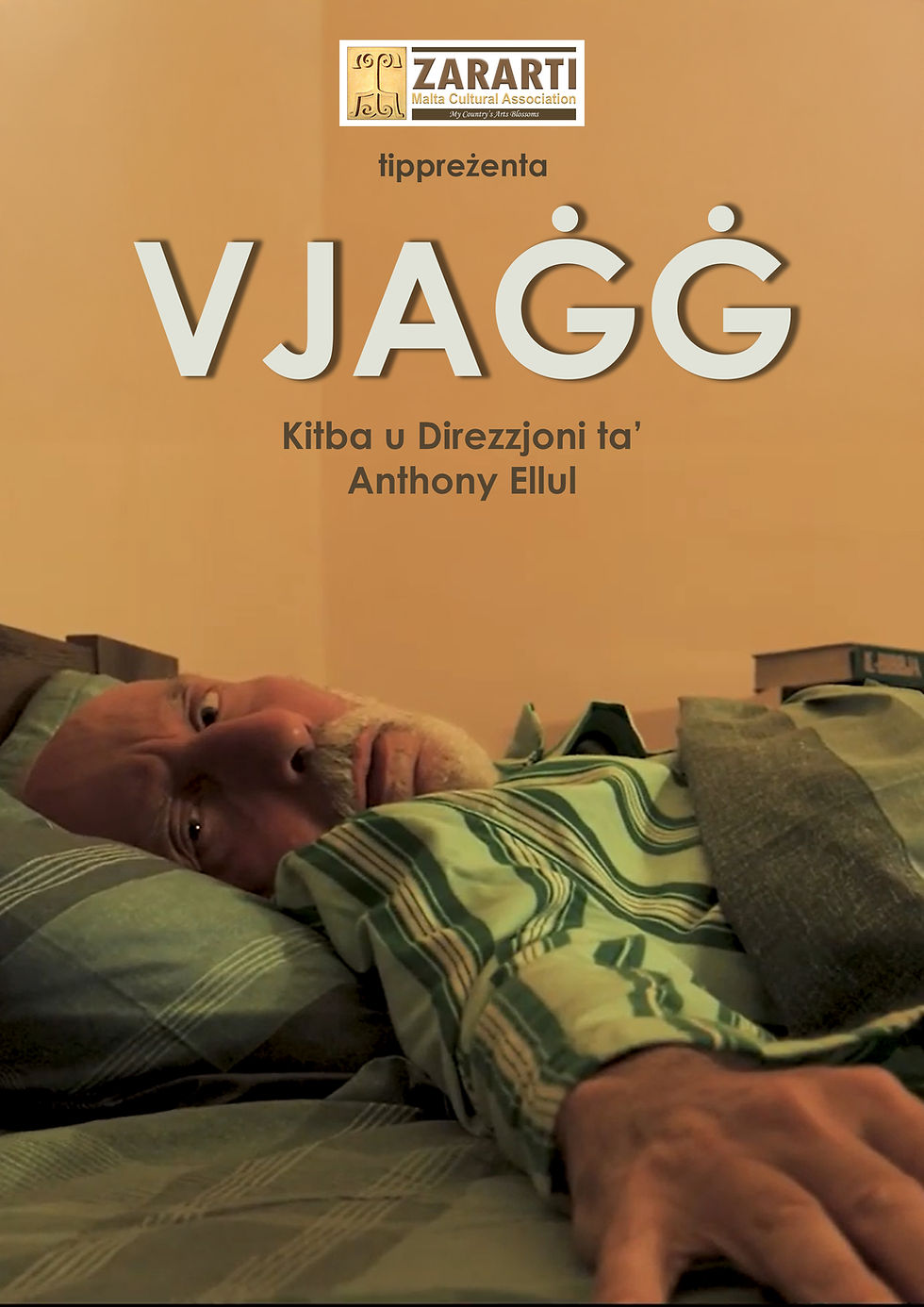
ZMCA also produced a short film drama “VJAĠĠ” (Journey) to show the effect of Dementia on the rest of the patient’s family. This was produced in the name of the Malta Dementia Society (MDS). MDS used this video as a basis of discussion in its regular talks for members and their families. ZMCA received the MDS 2024 award for Best Supporter of their organisation.


ZMCA PUBLISHING
As part of ZMCA’s project to promote awareness of the Maltese Cultural Heritage of Commedia Dell’Arte, it published a book written by Narcy Calamatta called WHY COMMEDIA? WHY MALTA? This book was launched at the Malta Istituto Italiano di Cultura in Valletta in 2019. A year later a translation of the book in Maltese, GĦALIEX KUMMIEDJA? GĦALIEX MALTA? was also published by ZMCA.
Other publications of books by Narcy Calamatta with a theatrical theme were published by ZMCA as follows:
1,2,3 LOVE - Three short comedies representing Socially Relevant Theatre.
ENDGAME BIL-MALTI a translation in Maltese of Samuel Beckett’s play, Endgame.
THE POINTING FINGER an original tragic drama in the Classical Greek Theatre Style.
META ĦATFU LIL PIANO – a play written in the context of a national debate about the future of Malta’s dilapidated former opera house.
Other publications are in the works.
